
How Thailand's virtual banks are supposed to reach the underserved
Thailand's virtual banks are justified by inclusion: serving thin-file households and small businesses that traditional branches cannot reach economically, using data instead of a credit bureau score.
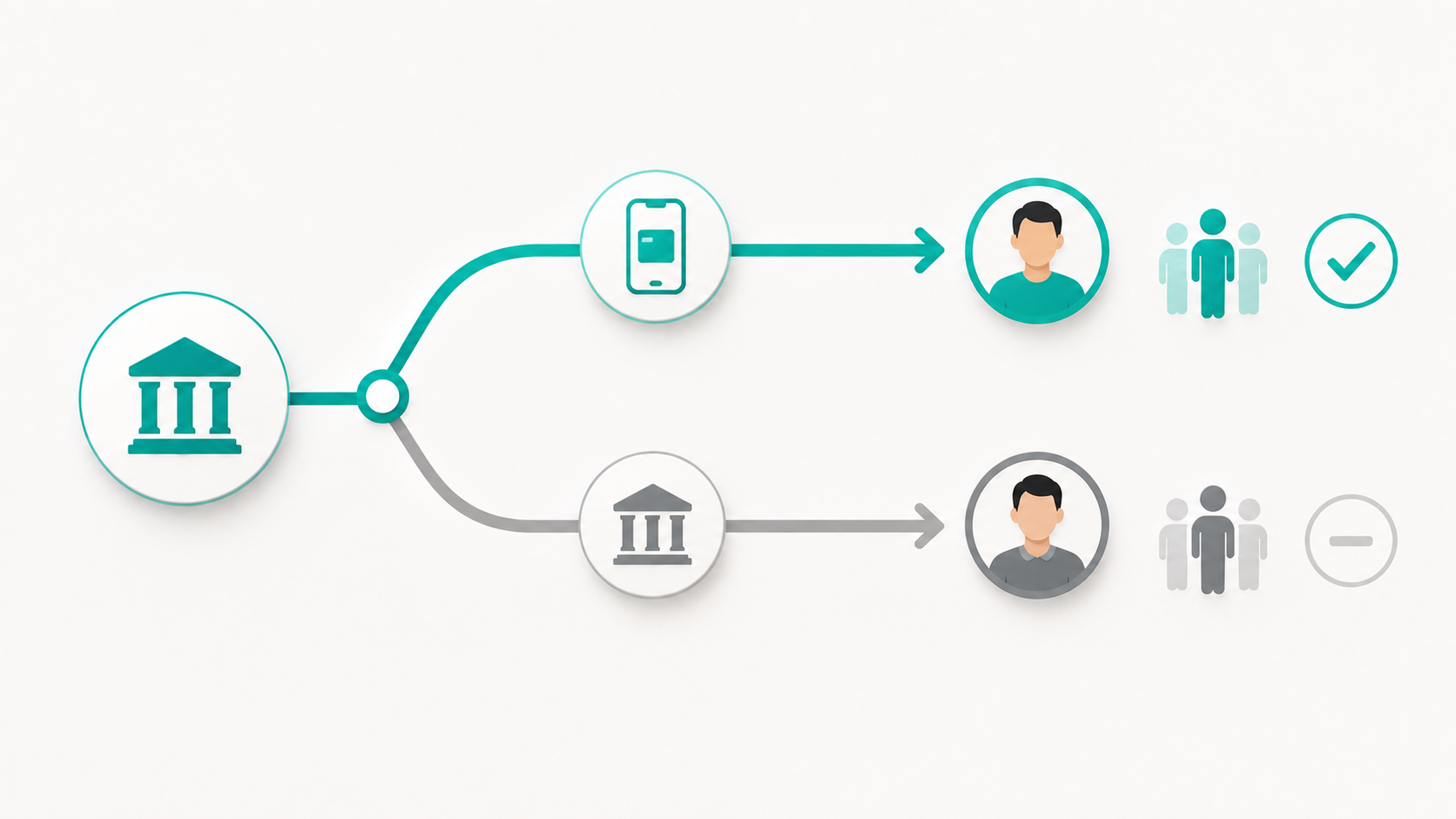
The official justification for Thailand's virtual banks is inclusion. The Bank of Thailand's case is that a large share of Thai households and small businesses are thin-file or underbanked, meaning they have little or no formal credit history, and traditional branches cannot serve them profitably. A virtual bank, the argument goes, can reach them through a phone and underwrite them on data a branch would never collect. The model is laid out in our piece on what Thailand's virtual banks actually are.
Who the underserved are
The underserved in Thailand span two groups. One is households outside the formal banking system, often in rural or peri-urban areas, who rely on cash and informal lenders. The other is small and micro businesses, market vendors, gig workers, and freelancers, whose irregular income and missing paperwork make them poor fits for branch-based underwriting. Both groups transact constantly through phones and e-commerce, which means the data to underwrite them exists. It just lives outside the credit bureau. Virtual banks are built to use it. The delay in reaching them is partly the regulator's caution, covered in why Thailand's virtual banks were delayed.
How data underwriting works
Instead of relying only on a credit bureau score, a virtual bank uses behavioural signals: payment history, e-commerce activity, telco usage, and app engagement. That lets it score a customer a traditional lender would decline. The technique is proven across Asia, and Ant International's backing of Ascend Money brings exactly this capability to Thailand, as we detail in the Ascend Bank Thailand market piece. Data underwriting only pays off at scale, which is why the Bank of Thailand attached a 5 billion baht capital floor, so the banks can absorb early losses while they build the book.
- Households outside formal banking, often rural or peri-urban
- Small and micro businesses with irregular income
- Gig workers and freelancers with thin paperwork
- Underwritten on behavioural data, not just a bureau score
Will they actually reach them
The honest risk is that virtual banks compete for the already-banked instead of the underserved, because the already-banked are cheaper to acquire and safer to lend to. The consortium model is the Bank of Thailand's hedge against that: each winner brings a distribution asset aimed at exactly the thin-file segment, whether it is Ascend's app, Krungthai's rural reach, or SCBX's digital base. But distribution is not destiny. The real test is whether the banks price products the underserved can use, micro-loans, low-balance accounts, and fair credit, rather than simply marketing a slick app to people who already have a bank. The three winners and their strategies are compared in the Thailand virtual bank licence winners article.
The test is not whether virtual banks launch. It is whether they lend to the people branches never would.
What this means for operators
For operators and policymakers, the inclusion thesis only works if the products are built for thin-file customers from the start. That means low minimum balances, transparent small-loan pricing, and onboarding that works on a basic smartphone. The Bank of Thailand's sandbox will constrain early product scope, which is the right place to prove inclusion before scale. The comparison with Singapore shows a different route to the same goal, as our Thailand versus Singapore digital banking piece explains.
The bigger picture
Virtual banking in Thailand is ultimately an inclusion bet dressed as a fintech story. If the three winners convert even a meaningful slice of the thin-file segment into banked customers, the programme is a quiet success that reshapes who has access to credit in the country. If they merely reshuffle the already-banked, the programme is a more efficient banking market but not the inclusion breakthrough its licence case promised. The difference will be visible within the first two years of operation, in the loan books more than the app downloads.
What to watch next
Track each bank's first-year credit mix: the share of loans to first-time borrowers is the cleanest signal of whether the inclusion thesis is real. Deposits from the already-banked are easy; net-new credit to the underserved is the proof. The Bank of Thailand's published data on the virtual bank cohort will make that comparison possible once the banks are live in 2026.
Who are Thailand's underserved banking customers?
They are mainly households outside the formal banking system, often rural or peri-urban, and small or micro businesses, gig workers, and freelancers whose irregular income and thin paperwork make them poor fits for branch-based underwriting.
How will virtual banks underwrite them?
By using behavioural data such as payment history, e-commerce activity, and telco usage instead of relying only on a traditional credit bureau score, which lets them serve customers a branch-based lender would decline.