Singapore fintech cools on events, breaks out on operators
Singapore fintech event searches fell 30 to 50 percent last week, but Airwallex and the NUS Fintech Society broke out while 'fintech innovation' rose. The market is shifting from discovery to operators.
The search bar is a better analyst than most think. Google Trends data for Singapore over the past week shows a fintech conversation in visible transition. The broad, awareness-level queries are fading, while a handful of specific names and one substantive theme are climbing. For operators and investors watching Southeast Asia's flagship fintech hub, the pattern is more informative than any conference agenda.
What is cooling, and what it signals
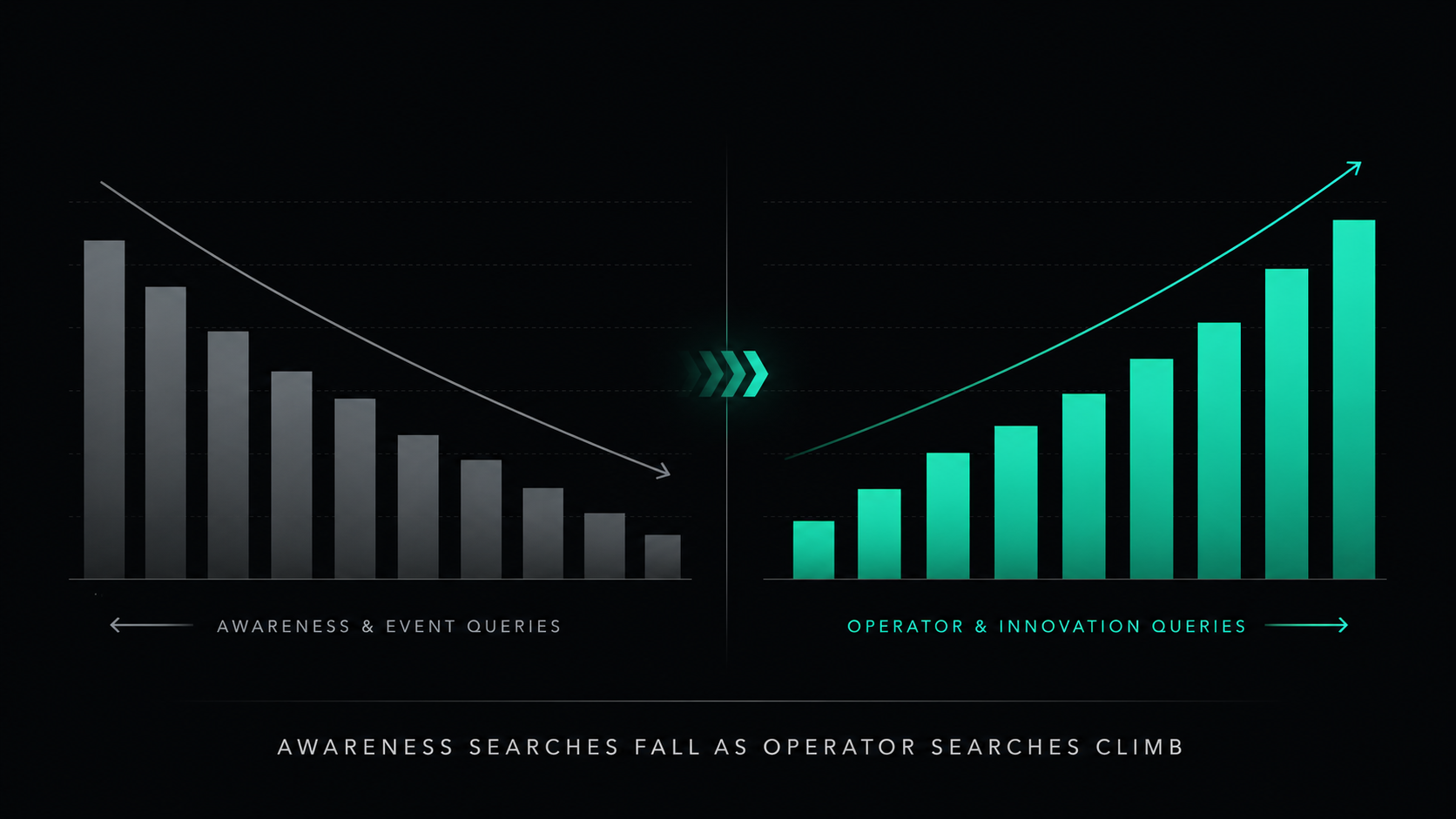
Every generic fintech query in the Singapore set lost ground week on week. 'Fintech festival' and 'Singapore fintech festival 2026' each fell about 40 percent. 'Fintech singapore', 'Singapore fintech association', and 'fintech companies in singapore' followed the same path. Even the most basic discovery terms slipped: 'what is fintech' and 'fintech meaning' dropped around 30 percent, and 'fintech jobs singapore' fell roughly half. See the Singapore Fintech Festival site and the Singapore Fintech Association for the institutions behind the softening event interest.
This is not a story of collapse. It is a story of saturation. When a market is young, people search 'what is fintech' and 'fintech jobs' because they are orienting. When it matures, those searches decline not because interest died but because the audience already knows the answer. The cooling of awareness queries is the fingerprint of a market that has moved past introduction.
- Event and festival queries down 30 to 50 percent
- Foundational terms ('what is fintech', 'fintech meaning') down about 30 percent
- Job and association searches down, signalling a settled talent and ecosystem map
- Discovery traffic giving way to operator and product interest
The breakout names
Against the cooling backdrop, two entries broke out. Airwallex, the cross-border payments firm with dual headquarters in Singapore and San Francisco, surged as a breakout query. So did the NUS Fintech Society, the student-led fintech club at the National University of Singapore. One is a commercial operator valued at roughly $11 billion after a 2026 Series H round. The other is a campus community. Together they map the two ends of a maturing ecosystem: the scaled company and the talent pipeline feeding it.
Airwallex's rise is backed by fundamentals, not just search. The firm has raised close to $2 billion since 2015, serves more than 150,000 businesses across 150-plus countries, and passed $1 billion in annualized run-rate revenue in late 2025. It has also moved into physical retail with a point-of-sale product, stepping toward Adyen and Stripe on their home turf. When a company becomes a search term on its own, it has crossed from category participant to category definer.
Why the north is heating on innovation
One query rose rather than fell: 'fintech innovation', up about 40 percent and concentrated in the north of the island. That geographic tilt is worth noting. The north is where several of Singapore's research and innovation nodes sit, and a rise there suggests the conversation is shifting from 'who is hiring' to 'what is being built'. Innovation as a search theme is the counterpart to the falling awareness terms. People stop asking what fintech is and start asking what is new.
From awareness to building
The NUS Fintech Lab, running since 2019, and the society's industry-grade projects, including work with Xfers on transaction risk, show the talent side of that shift. A breakout campus club is anearly signal that students are treating fintech as a buildable craft, not a career rumour. The search breakout of a student society is the talent market telling you the next Airwallex is already in a workshop somewhere.
When a company becomes a search term on its own, it has crossed from category participant to category definer.
What the festival decline really means
The pullback in festival searches should not be read as waning relevance for the Singapore FinTech Festival itself, which remains the region's largest gathering and is set for 18 to 20 November 2026 at Singapore EXPO under the Monetary Authority of Singapore and Elevandi. It means the festival is now a fixture rather than a discovery. People do not search for something they already have on the calendar. The drop is the sound of an institution becoming routine.
For sponsors and platforms, that changes the calculus. Awareness-stage booths convert less when the crowd already knows the category. The value of the festival moves from education to dealmaking, and the search data is the leading indicator of that migration. Brands should weight their presence toward operator relationships and less toward explaining what fintech is.
What this means for operators
The trend is a permission slip to stop marketing the category and start marketing the product. Singapore's fintech audience has been educated. The searches now reward specific operators (Airwallex), specific communities (NUS Fintech Society), and specific substance ('fintech innovation'). Generic thought leadership will rank below the signal the market is now sending: show the build, name the operator, prove the pipeline.
Does falling fintech search interest mean the Singapore market is shrinking?
No. The decline is concentrated in awareness and event queries, which typically fall as a market matures. Operator and innovation searches are rising, a sign of depth rather than contraction.
Why did Airwallex break out as a search term?
Airwallex has scaled to roughly $11 billion valuation, serves 150,000-plus businesses, and expanded into point-of-sale, making it a definer of the cross-border payments category rather than a participant in it.
What does a student society trending tell us?
The NUS Fintech Society breakout signals a strong, build-oriented talent pipeline, an early indicator that the next wave of Singapore fintech operators is already forming.
Search trends are noisy week to week, but the shape here is coherent. Singapore fintech is shedding its discovery phase: the crowded, curious, awareness-driven searches are cooling, while the names that ship and the students who build are breaking out. A market that stops asking what fintech is has usually started deciding who wins, and the data says Singapore has already made that turn.
Speak with the SpinDepth desk