
$155 Billion Just Vanished From Global Markets in 24 Hours & The Reason Is Sitting in the Persian Gulf.
Over the weekend, the US bombed Iranian radar and drone sites. Iran retaliated against a US air base. Kuwait's army confirmed intercepting hostile missiles on Monday morning. Roughly $155 billion in global equity market value vanished within 24 hours. The Strait of Hormuz remains closed. The MOU remains unsigned. And the most dangerous part of this story has not yet been priced.
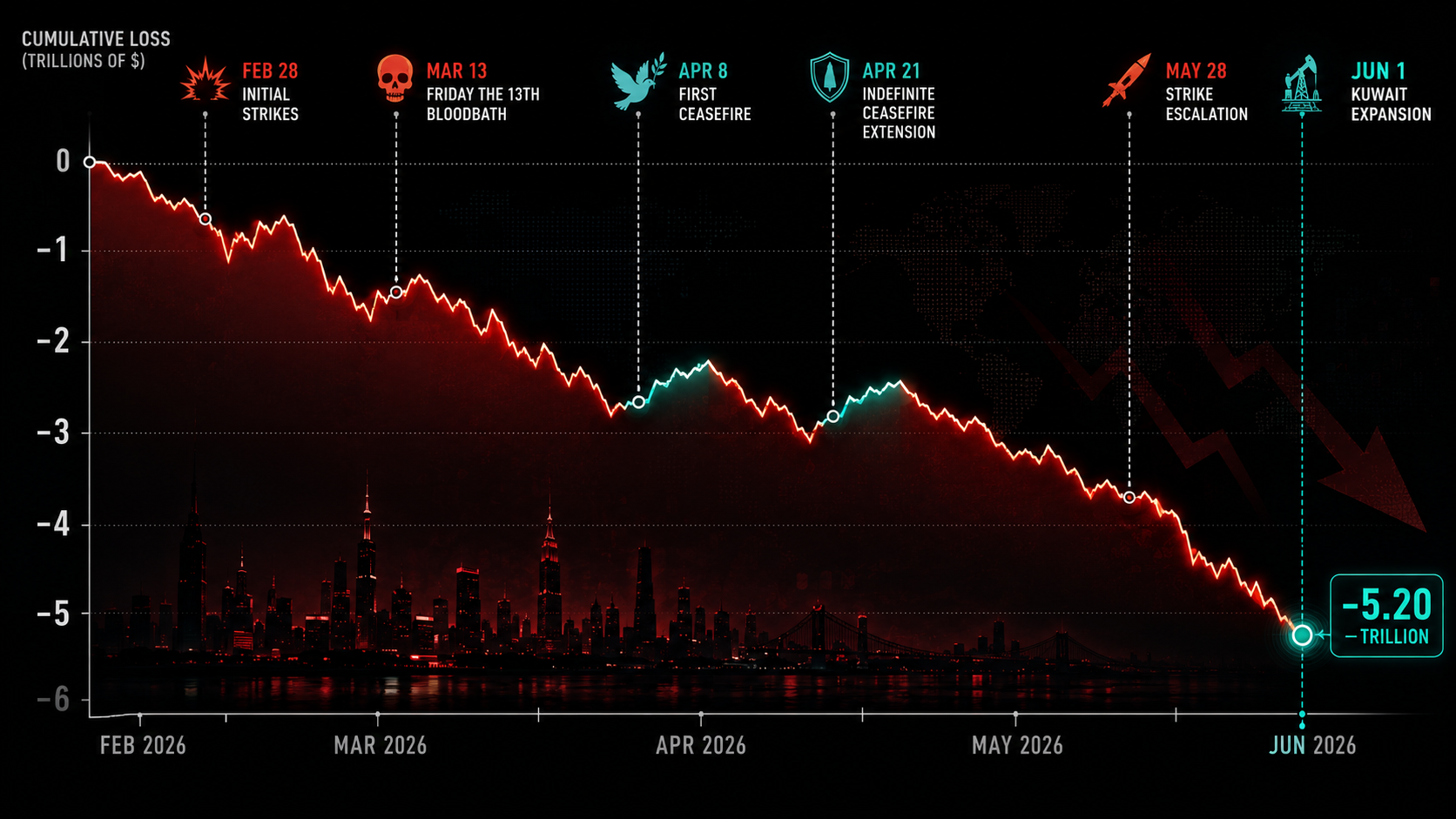
By the end of the Asia-Pacific trading session on Monday June 1, 2026, approximately $155 billion in global equity market value had been erased in a single session. Asian markets opened sharply lower. European futures followed. US equity futures dropped before the cash open. The headline price moves were sharp but not extreme by the standards of this conflict, which has already wiped more than $5 trillion from US equities alone since the war began on February 28. What makes the Monday June 1 episode commercially significant is not the magnitude of the move. It is the specific combination of events that produced it, and the fact that the most consequential element of the trigger has still not been priced by markets that are watching the wrong indicator.
Over the weekend, the United States military carried out what it described as self-defence strikes against Iranian radar and drone control sites following Iran shooting down an American drone. NBC News confirmed the strikes through US Central Command and reported Iran's claim that it had targeted an air base used in the US attack. By Monday morning, the Kuwaiti army announced on X that it was responding to hostile missile and drone threats over its territory and that any sounds of explosions heard were the result of air defence systems intercepting attacks. NPR reported that the US had intercepted Iranian missiles targeting American soldiers in Kuwait. President Trump stated that the ceasefire was on life support.
The MOU that negotiators had drafted in late May has not been signed. The Strait of Hormuz, closed by Iranian action in response to the original February 28 strikes, remains physically blocked. Iranian crude loadings remain near zero. The Ras Laffan LNG complex in Qatar continues to operate at reduced capacity following infrastructure damage from earlier in the conflict. And now Kuwait, which has not been a direct combatant in this war and is one of the United States' most reliable Gulf security partners, is intercepting Iranian missiles on its own territory. This is the escalation that markets have not yet fully priced. The geographic expansion of active conflict, from a US-Iran direct exchange to a Gulf-wide active warzone involving Kuwait, changes the structural risk picture in ways that the initial Monday morning sell-off has only begun to reflect.
The 24-Hour Market Damage and What It Reveals
The approximately $155 billion in global equity value erased on Monday June 1 broke down across asset classes and regions in a pattern that the conflict has produced repeatedly. Asian equities led the decline, with Japanese, Korean, and Southeast Asian indices opening sharply lower as the weekend escalation news was absorbed in the first available trading window. European equity futures followed. US equity futures pointed lower before the cash open. Oil moved higher, with Brent gaining as the market priced an extended supply disruption rather than a near-term resolution. Gold gained on safe-haven demand. The dollar strengthened on the conventional risk-off response. Bitcoin and broader crypto markets fell.
What is commercially significant about the $155 billion figure is what it does not represent. It is not the peak damage of the conflict. The March 13 single-session loss exceeded $1 trillion, driven by the combination of escalating war news and weak US economic data. The cumulative loss since the war began on February 28 has exceeded $5 trillion in US equities alone. The $155 billion Monday figure represents a market that has become structurally accustomed to absorbing geopolitical shocks of this magnitude as routine session-level events. The desensitisation is itself a commercial signal. Markets that no longer respond proportionally to escalations of this scale have either fully priced the worst-case scenario or are systematically underpricing it. Both interpretations are analytically possible. The evidence supports the second.
The Kuwait Expansion Is the Story Markets Are Missing
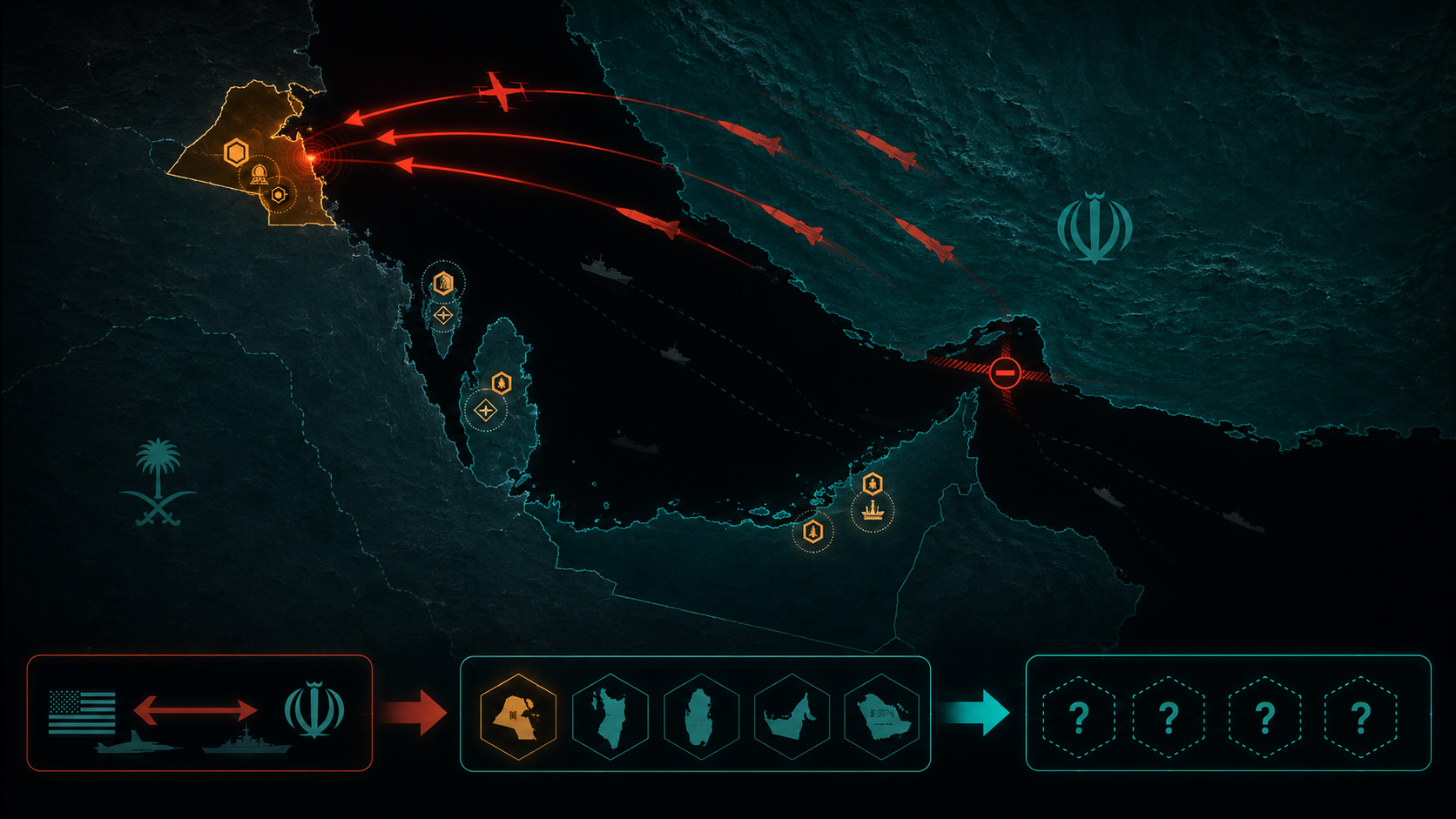
For the four months of this war so far, the active military exchange has been bilateral: the United States and Iran, with Israel as the third party in the initial February 28 operation. Other Gulf states have been affected, primarily through energy infrastructure proximity and shipping disruption, but they have not been the targets of direct Iranian military action. The Monday June 1 missile and drone attacks against Kuwait change this. Kuwait is a major non-NATO ally of the United States. It hosts approximately 13,500 US military personnel across multiple bases, including Ali Al Salem Air Base and Camp Arifjan. It is a member of OPEC and the Gulf Cooperation Council. It is one of the world's largest oil exporters.
An Iranian missile attack on Kuwait, even one that is intercepted by air defence systems, has implications that are structurally different from Iran striking US military positions inside Iraq, Syria, or international waters. Kuwait is a sovereign Gulf monarchy that has not been a party to this conflict. Iran attacking Kuwaiti territory directly draws Kuwait into the war as a target, which creates the legal, political, and military rationale for Kuwait to align more explicitly with the US-Israel position and to take measures, including potentially closing Kuwaiti ports to Iranian-affiliated shipping or hardening Kuwait's own air defence posture in ways that change the regional military balance. The other Gulf states, including the United Arab Emirates, Saudi Arabia, Qatar, and Bahrain, are now watching this dynamic with sharply elevated concern about whether they are next.
The market has not priced this. Oil's measured response on Monday, gold's modest gain, the disciplined risk-off behaviour of US equity futures, all of these reflect a market that is treating June 1 as another data point in the same pattern that has unfolded since February 28: strike, retaliation, partial pullback, more strikes. The Kuwait dimension makes this pattern materially different. A war that was bilateral and contained has become regional and structurally expansive in a single weekend. The probability of further Gulf state involvement is higher today than it was on Friday. The probability that the MOU gets signed at all is lower. The probability that the Strait of Hormuz reopens on a timeline that markets can predict has receded. None of these probability shifts have been fully absorbed into asset prices.
The Sectors Carrying the Damage and Why They Matter for Southeast Asia
Within the $155 billion in equity value erased on Monday, the sector distribution follows the same pattern that the March 3 selloff established: technology and semiconductors take the largest absolute and percentage losses, airlines and consumer discretionary lose on energy cost transmission, materials and industrials drop on global trade flow disruption concerns, energy stocks rise on the oil price move. The June 1 episode replicates this distribution, with the addition of an elevated focus on regional security companies, defence contractors, and air defence system manufacturers whose products are directly relevant to the Kuwait dimension of the escalation.
For Southeast Asian retail traders, the sector pattern has direct implications across the markets they most actively engage with. The technology selloff that began in early March and has accelerated through the conflict has hit the Kospi, the Nikkei, and the broader regional semiconductor supply chain disproportionately, because the AI and chip demand thesis that drove these markets to records in late April and early May depends on a global economic environment that the Iran war is actively eroding. Malaysian semiconductor manufacturers, Thai electronics exporters, and Vietnamese precision manufacturing firms are all exposed to the demand-side weakening that elevated energy costs and disrupted global trade flows generate. The structural ASEAN supply chain advantage that McKinsey identified earlier this year remains real, but it is now being weighed against macro headwinds that are intensifying rather than easing.
Gold's behaviour deserves specific attention. After spiking above $5,595 in January and falling to a two-month low of $4,380 on May 28 when the previous strike episode lifted the dollar, gold gained modestly on Monday morning as the Kuwait expansion added inflation and safe-haven concerns simultaneously. The setup is unusual: an event that is structurally bullish for gold via the safe-haven channel and structurally bearish via the dollar-strengthening channel. The net effect has been muted, which suggests the market is genuinely uncertain about which channel will dominate. Standard Chartered's view that gold will retest record highs remains intact, but the path is now more contingent on whether the Kuwait dimension produces further regional escalation than it was a week ago.
The $155 billion that vanished on Monday is not the damage. It is the deposit on the damage that has not yet been priced.
What Is and Is Not Being Said About the Real Cost of This War
The cumulative US economic cost of the Iran war has begun to be quantified in ways that are politically uncomfortable enough to have escaped mainstream financial media coverage. The Center for American Progress published an analysis on Monday morning citing US defence officials' private estimates that approximately $50 billion of the Department of Defense's annual budget, roughly 5 percent of FY2026 defence spending, has been expended on the war. Fortune previously reported top budget expert estimates that the war could cost the American economy as much as $210 billion. The $5 trillion in cumulative equity market value erased since February 28 is, in this context, only one dimension of the economic damage. The opportunity costs for domestic infrastructure, healthcare, and education spending; the inflationary drag on US consumer purchasing power from sustained elevated energy costs; the secondary impact on every economy that imports US-denominated commodities and goods; all of this compounds.
The controversial dimension of the June 1 escalation is not the military action itself. It is the structural question that the Kuwait expansion forces into the open: is this war advancing any objective that justifies the cumulative cost it is generating? US Vice President JD Vance stated last week that negotiators were trying to strike general terms on Iran's nuclear program, with the specifics to be hammered out later. The MOU that emerged from those discussions has not been signed by Trump, and on Monday he said the ceasefire was on life support. The Iranian government's response to the US peace proposal was swift enough that Trump's rejection of it came within hours. The trajectory of the conflict, fourteen weeks in, is not toward resolution. It is toward expansion, with Kuwait now drawn directly into the active warzone.
Markets are not the appropriate institution to render the political judgment about whether this war is justified. But markets are the appropriate institution to price the economic consequences of its continuation, and the June 1 episode reveals that they are not yet doing so accurately. The $155 billion lost on Monday is small relative to the cumulative damage already incurred. It is also small relative to the additional damage that the Kuwait expansion implies for the months ahead if the pattern of bilateral conflict expanding into regional conflict continues to play out at its current pace.
What Financial Brands Need to Be Communicating to Their Audiences Right Now
For financial brands serving retail traders across Southeast Asia, the June 1 escalation is the kind of event that defines the difference between brands that build long-term audience trust and brands that produce reactive content. The retail trader in Bangkok, Ho Chi Minh City, Jakarta, or Kuala Lumpur who opens their phone on Monday morning and sees that $155 billion has vanished from global markets while Iran is firing missiles at Kuwait does not need another generic market wrap. They need an explanation of what has actually happened, what it specifically means for the ASEAN currencies, regional indices, and commodity CFD positions they are managing, and what the analytical framework is for thinking about whether to add, hold, or reduce exposure across each of those positions in light of the new information.
Providing that level of analytical content, in Thai, Vietnamese, Bahasa Indonesia, and Bahasa Malaysia, on the morning of an escalation rather than three days later, is the form of market intelligence that builds the strongest commercial brand authority in the current environment. The brands that have built the analytical infrastructure to do this consistently are extracting compounding trust value from every escalation episode. The brands that are still producing day-of-event commentary that reads as a translated headline summary are demonstrating, to the most commercially valuable segment of their potential audience, that they do not actually have the analytical capability that their marketing claims. In a market environment defined by 14 weeks of war, $5 trillion in cumulative equity damage, and an active expansion into Kuwait that has not yet been fully priced, that demonstration is commercially decisive.